
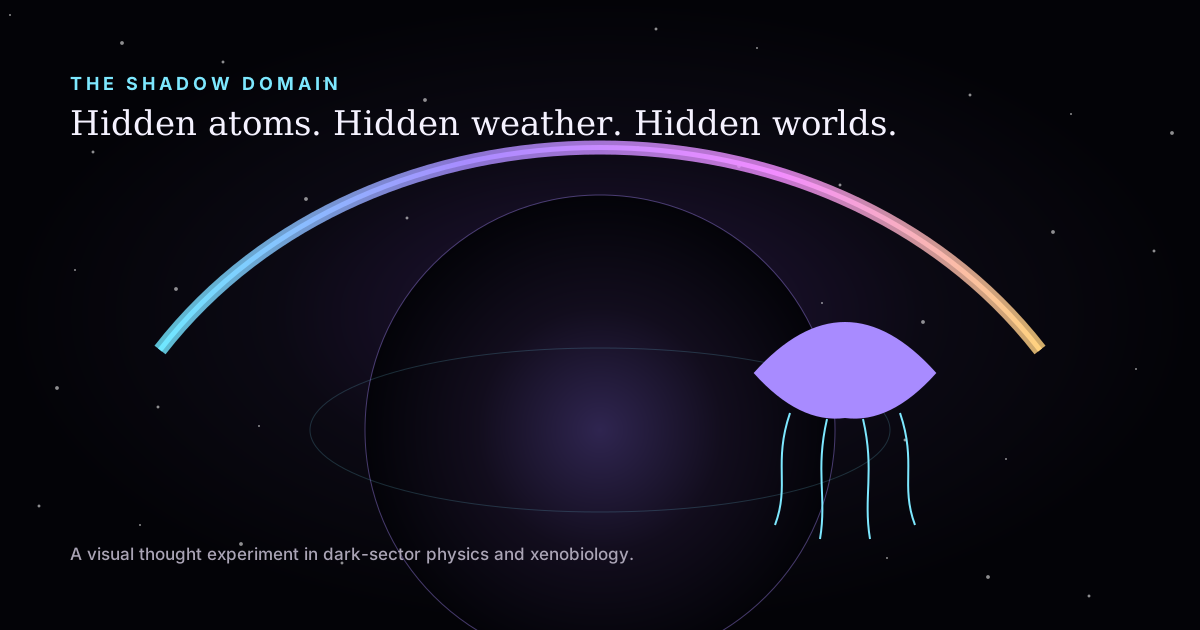
I started with a deliberately primitive question: if ordinary rainbows are photons interacting with ordinary matter, what would the equivalent phenomenon look like inside a hidden sector whose particles barely talk to ours?
The useful version of that question is not “what color is dark matter?” It is this: if a dark sector contains its own force carriers, bound states, cooling channels, and composite matter, how far can complexity go before the analogy to chemistry, weather, worlds, and ecology stops being useful?
1. The physics underneath the metaphor
Dark matter is established observationally through gravity, but its microscopic nature remains unknown. The simplest models model it as effectively collisionless. A much richer family of models allows dark matter to participate in a hidden sector with its own interactions. Atomic dark matter models, for example, introduce oppositely charged dark fermions bound by a hidden U(1) force and coupled to a bath of dark photons. Those particles can recombine into neutral atom-like states and imprint dark acoustic oscillations on cosmic structure.
This matters because it gives us a legitimate foothold for asking about a “Shadow Domain.” Once a hidden sector has radiation, bound states and dissipation, it no longer has to behave like invisible dust. It can possess thermodynamics.
2. Dark atoms and the possibility of dark chemistry
In atomic dark matter, the relevant parameters are not our electron mass, proton mass or electromagnetic fine-structure constant. They are hidden-sector analogues: a dark electron mass, dark proton mass, dark fine-structure constant, and the temperature history of the dark radiation bath. Change those values and you change the size of dark atoms, their binding energy, transition spectra, collisional behavior and cooling rates.
That does not give us a hidden periodic table automatically. But it does make the phrase dark material meaningful rather than purely poetic. Composite dark matter can also arise from confining hidden gauge theories, producing dark mesons, baryons, glueballs and other bound states. The chemistry could therefore be mirror-like, hydrogenic, strongly confining, or something with no clean analogue in ordinary matter.
3. Dark rainbows
A terrestrial rainbow needs three things: radiation, a medium, and wavelength-dependent refraction or scattering. A dark-sector rainbow would need the same logical ingredients, but not ordinary visible photons.
If a hidden U(1) supplies dark photons, and if hidden matter can form droplets, aerosols, crystals or density gradients whose response changes with dark-photon frequency, then the sector could support a genuine dispersion phenomenon. A dark-sector observer might experience the result as a spectrum. We would not necessarily see it at all.
The rainbow shown in the visual atlas is therefore false color. Cyan, violet, magenta and gold are being used as a translation layer for the ape brain. They stand for different hidden-sector frequencies or interaction regimes, not a claim that dark photons are secretly purple.
4. What would a dark world be made of?
If hidden matter is dissipative, it can radiate energy and potentially collapse into denser structures rather than remaining a diffuse halo forever. That opens the possibility of dark disks, compact bodies and stratified fluid environments in some model classes.
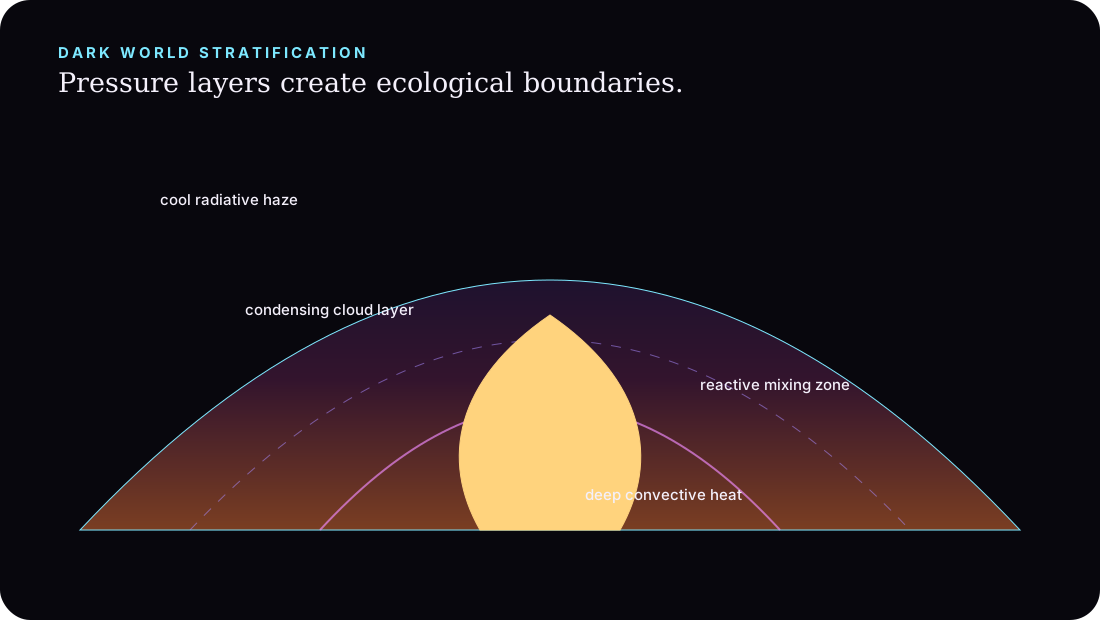
My working picture is deliberately Neptune-like: not because a dark planet must resemble Neptune, but because a pressure-layered fluid world is a better first analogy than an Earth clone. The upper layers could be cooler, diffuse hidden gas or plasma. Deeper layers could transition through condensed phases that have no ordinary-matter counterpart. Still deeper, gravitational compression and trapped heat could maintain violent convection.
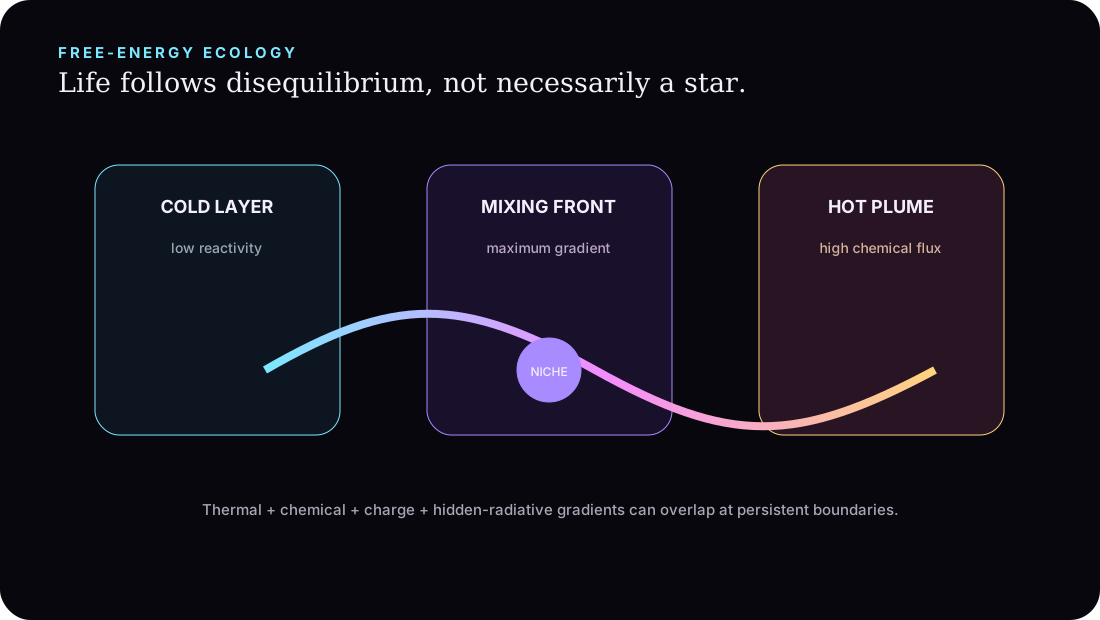
In this picture, “vents” are not cracks in rock. They are persistent upwellings where deep hot material, charge, reactive compounds or radiation enter a cooler layer. That is the key ecological idea: life does not require sunlight; it requires usable free-energy gradients.
5. Vent ecology without a sun
On Earth, hydrothermal vent ecosystems demonstrate that sunlight is not the only way to power an ecology. Chemosynthetic organisms exploit redox disequilibria. A shadow-world analogue could exploit thermal gradients, chemical gradients, charge separation, dark-radiative flux or combinations of them.
The most interesting habitats would therefore be boundaries: plume edges, cloud interfaces, shear layers, ionization fronts and zones where a hot deep component mixes with a cooler upper atmosphere. Those interfaces are continuously driven away from equilibrium. If sufficiently complex self-organizing chemistry exists, those are exactly the places where I would look first.
6. A speculative shadow extremophile
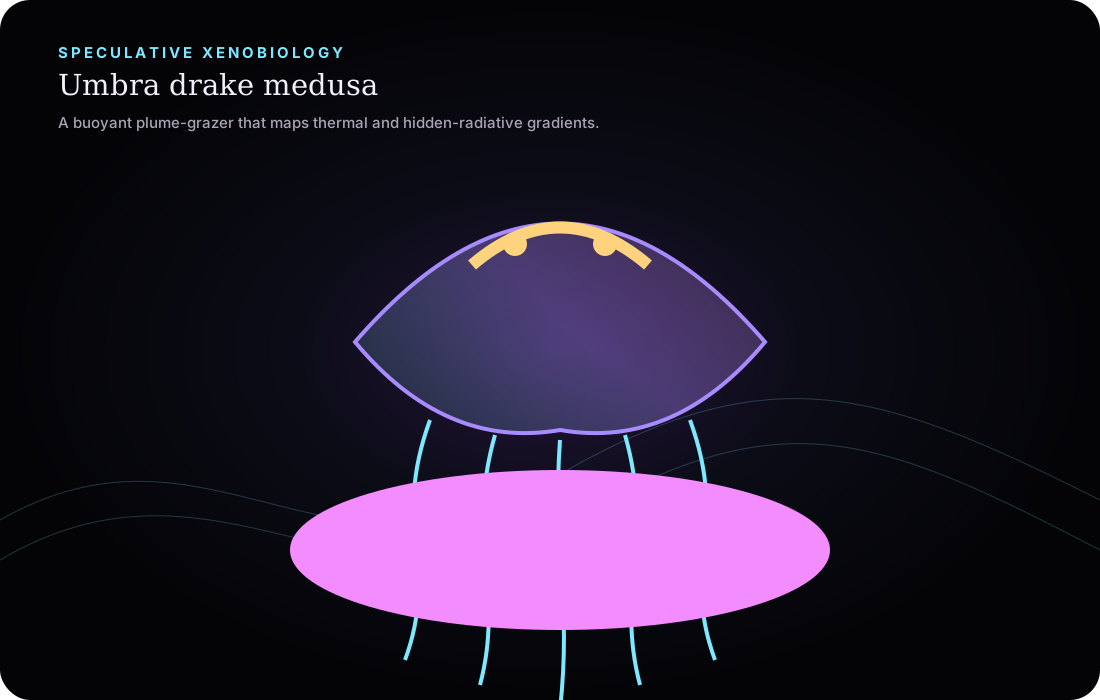
To force the idea into something our brains can visualize, I designed a hypothetical organism: the umbra drake medusa. This is not a prediction. It is a constrained xenobiology thought experiment.
The animal combines a jellyfish-like body plan with a reptile-like sensory crest. A broad translucent bell provides enormous surface area for buoyancy, radiation exchange and chemistry. Long tendrils trail into plume material and function as filters, electrochemical collectors and distributed sensory organs.
The “eyes” are paired pit organs rather than camera eyes. A terrestrial pit viper can detect infrared radiation because warm objects create detectable thermal gradients. The shadow organism would generalize that strategy: its sensory crest maps long-wavelength thermal radiation, dark-radiative intensity, local ionization and convective structure. Its world would look less like a photograph and more like a continuously changing weather radar.
It would not flap like a bird. In a dense atmosphere, buoyancy and convection are cheaper. Internal sacs or low-density chambers could regulate altitude while slow muscular pulses trim the organism across rising and sinking flows. In effect, it would sail the atmosphere.
Its metabolism would be radiothermochemical. One membrane system would absorb long-wavelength energy while catalytic surfaces exploit reactive material carried upward in vent plumes. The organism would spend much of its life circling persistent convection towers the way terrestrial grazers gather around a food source.
7. Matter shadows
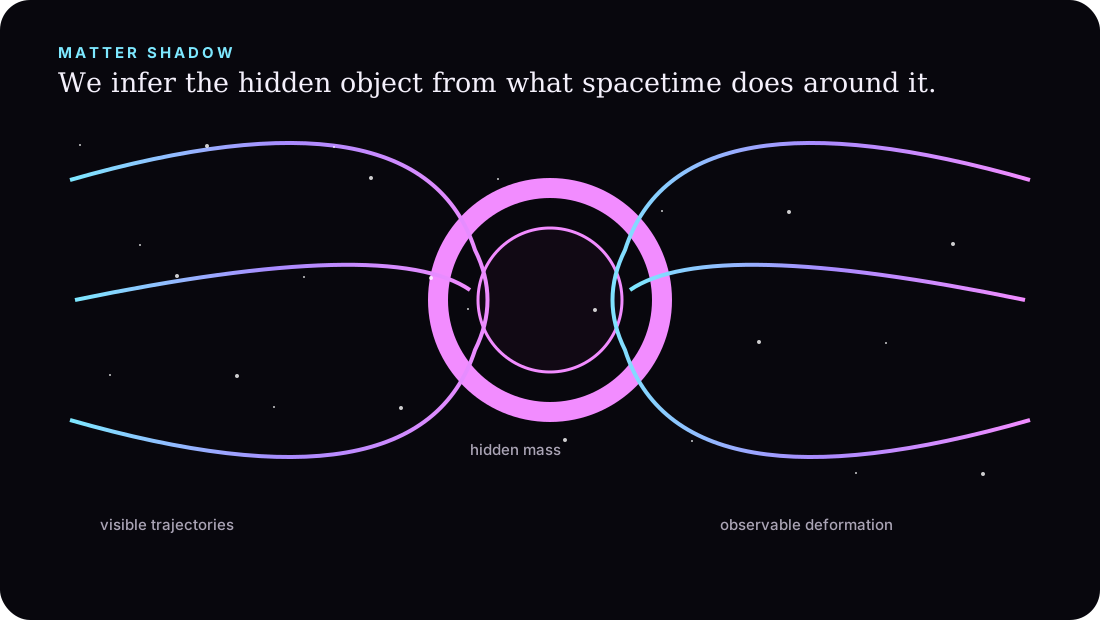
The second major idea is the matter shadow. A hidden object that does not interact electromagnetically with ordinary matter does not cast a normal optical shadow. But it can still leave an imprint in our sector through gravity.
The most conservative form of a matter shadow is therefore gravitational: lensing, orbital perturbations, halo structure or visible matter arranged around mass that cannot itself be seen. The object is inferred from the deformation it produces.
Higher-dimensional and brane-world models provide a more literal mathematical metaphor. If visible and hidden matter occupy different sectors or branes while sharing gravitational geometry, an object could influence another sector without appearing as ordinary material inside it. Our observed structure would then be the lower-dimensional projection of something whose full ontology lives elsewhere.
I am calling that projection a matter shadow: not a confirmed new phenomenon, but a useful conceptual category for “observable structure generated by an inaccessible source.”
8. A layered Shadow Domain framework
The theory is easiest to keep honest if its claims are separated into four layers:
- Observed: dark matter exists gravitationally and dominates the matter budget of galaxies and large-scale structure.
- Serious active theory: dark sectors may contain self-interactions, dark photons, atomic bound states, dissipative plasmas, mirror sectors or confining hidden forces.
- Disciplined extrapolation: sufficiently dissipative hidden matter could support compact bodies, stratified fluids, radiative transfer, atmospheric-like circulation and spectral phenomena.
- Speculative xenobiology: if complex autocatalytic chemistry exists in such an environment, organisms could evolve around non-solar free-energy gradients.
9. What would falsify the picture?
The Shadow Domain becomes scientifically useful only if it points back toward observation. Atomic dark matter and other interacting-sector models are constrained by the cosmic microwave background, structure formation, halo morphology, cluster collisions, dark radiation and direct searches for portal interactions. Dark acoustic oscillations, altered halo mass functions, self-interaction signatures and kinetic mixing searches are therefore relevant empirical pressure points.
A sufficiently simple dark sector may never build anything remotely resembling a world. Many viable dark-matter candidates cannot. The Shadow Domain is not a claim that dark matter must be complex. It is a framework for asking how complex it could be without immediately violating known physics.
10. Conclusion
The interesting shift is conceptual. If dark matter possesses internal forces, radiation and bound states, then “dark matter” may describe a category of matter rather than a single invisible substance. Under some models there could be hidden atomic physics, hidden plasma physics, hidden cooling and hidden structure occurring around us while our electromagnetic senses remain almost completely blind to it.
From there, dark rainbows, dark worlds and shadow extremophiles are no longer assertions. They are controlled thought experiments built on top of real dark-sector theory.
And the matter shadow becomes the bridge between the two domains: we do not see the hidden object; we see what reality has to do around it.
Selected scientific foundations
- Kaplan, Krnjaic, Rehermann & Wells, Atomic Dark Matter, arXiv:0909.0753.
- Cyr-Racine & Sigurdson, The Cosmology of Atomic Dark Matter, Phys. Rev. D 87, 103515 (2013), arXiv:1209.5752.
- Cline, Dark atoms and composite dark matter, arXiv:2108.10314.
- Fabbrichesi, Gabrielli & Lanfranchi, The Dark Photon, arXiv:2005.01515.
- Foot, Dissipative dark matter halos: The steady state solution, arXiv:1707.02528.
- Foot, Mirror dark matter: Cosmology, galaxy structure and direct detection, arXiv:1401.3965.
- Asadi, Batz & Kribs, Rich Phenomenology from Simple Ingredients: A Review of Confining Dark Sectors, arXiv:2606.30760.
- Sarrazin & Petit, Brane matter, hidden or mirror matter, their various avatars and mixings, arXiv:1208.2014.