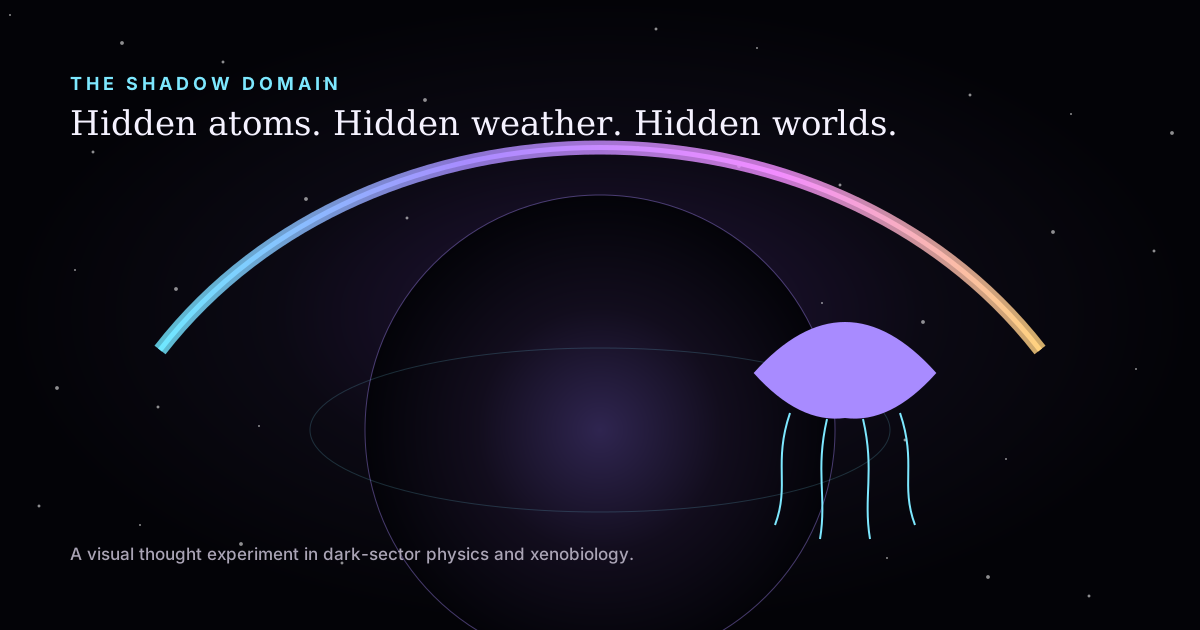
Shadow Domain: Dark Worlds, Dark Rainbows, and Matter Shadows
A physics-grounded thought experiment about hidden-sector atoms, dark photons, dissipative worlds, vent ecologies, matter shadows, and the strange life that might inhabit them.
The questions I can’t leave alone — worked out in public across science, systems, technology, philosophy, and whatever connects them.
Quick thoughts start on HySocial. The ones with teeth turn into research threads and essays here.
What if dark matter is not merely invisible mass, but a hidden sector with its own radiation, bound states, chemistry, worlds, weather, and evolutionary niches?
The paper separates established evidence, active dark-sector theory, disciplined extrapolation, and pure xenobiological speculation. Interactive diagrams walk from hidden microphysics to a Neptune-like shadow world, vent ecology, a thermal-sighted flying extremophile, and the gravitational projection we call a matter shadow.
Enter the Shadow Domain →Ideas that were worth slowing down, researching, and writing properly.
A physics-grounded thought experiment about hidden-sector atoms, dark photons, dissipative worlds, vent ecologies, matter shadows, and the strange life that might inhabit them.

Why I stopped treating AI as a chatbot and started building a governed system of agents, memory, tools, queues, release gates, and human authority.

What building large software systems taught me about genomes: redundancy, repair, branching, mobile code, and why a pangenome looks less like a master file than a distributed history.
New releases, experiments, and whatever came crawling out of the studio.
Follow Hucifer on SoundCloud ↗ UNAUTHORIZED TRANSMISSIONS
Bass, science, space, and a questionable amount of ambition. Pick a track and hit play.
A quick thought is only the trigger. It gets a second look, research, and a serious attempt to break it before it becomes something permanent.
1 public quick thought · the useful ones grow into essays.
Open my HySocial profile ↗
Tap a node. The insight card explains the topic in plain English and gives you a useful next move.
Hucifer is the permanent archive. These are the live edges: identity, links, conversation, and contact.
This is not a polished “personal brand” museum. It is a working public notebook: ideas, mistakes, models, discoveries, systems, and questions preserved so other people can explore them instead of watching them disappear into a feed.
Sign in to draft something, submit it for review, or keep building on a thread you started.